
Olivia Wolf · 3 November 2026
Navigating Content Adaptation Challenges in Multi-Jurisdictional Online Platforms Using Advanced Masking Protocols
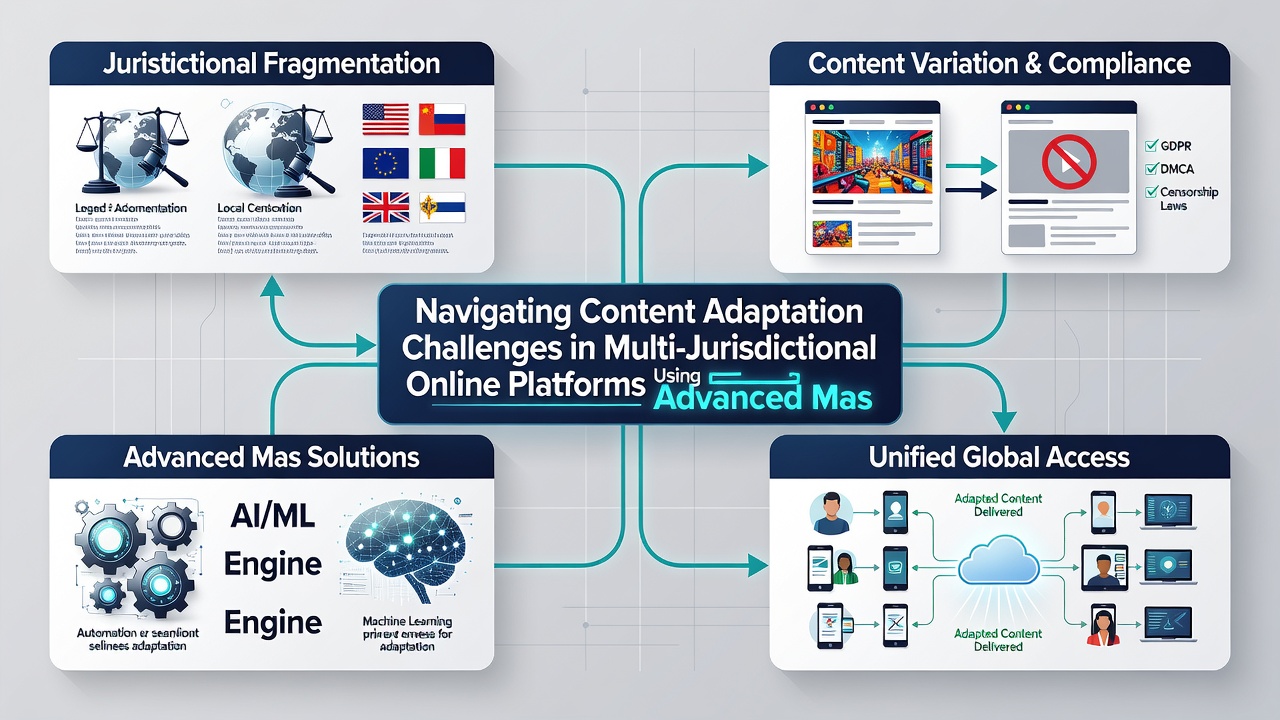
Online platforms operating across multiple countries face ongoing requirements to adjust digital content in line with varying national regulations on data handling, expression limits, and consumer protections, and advanced masking protocols provide one technical approach to meeting those demands without fragmenting core infrastructure. These protocols rely on dynamic filtering layers that obscure or redirect specific elements based on detected user location, device signals, and regulatory triggers, allowing a single service architecture to serve differentiated experiences while maintaining operational continuity.
Core Pressures Across Borders
Regulatory frameworks differ sharply between regions, with the European Union's data protection rules requiring explicit consent mechanisms and data minimization, whereas frameworks in other jurisdictions emphasize content removal timelines or age-verification mandates. Observers note that platforms must track updates from bodies such as the European Commission and the Australian Competition and Consumer Commission, each issuing guidance on digital service obligations at different intervals. Data from regulatory filings indicate that non-compliance incidents rose steadily through 2025, prompting operators to adopt automated systems capable of real-time jurisdictional mapping.
November 2026 marks the scheduled enforcement date for several harmonized digital services amendments under review in multiple Asia-Pacific markets, creating an additional synchronization challenge for platforms that already manage separate rule sets for North American and European users. Those who've studied compliance patterns report that manual updates become impractical once user bases exceed several million daily active sessions, which is why masking solutions gained traction as a scalable alternative.
How Masking Protocols Function in Practice
Advanced masking operates through a combination of IP geolocation databases, behavioral heuristics, and encrypted rule engines that apply content overlays or suppressions at the edge server level. When a request arrives, the system evaluates the originating jurisdiction against a maintained rule matrix and activates the corresponding mask, such as blurring restricted imagery, substituting localized terms, or routing certain data flows through anonymized processing nodes. Researchers at academic institutions have documented that such layers reduce latency compared with full content duplication strategies because only the differing elements undergo transformation rather than entire pages or media streams.
Integration with Existing Delivery Systems
Platforms integrate these protocols within content delivery networks by inserting middleware that communicates with centralized policy repositories. The approach avoids storing multiple static versions of assets and instead generates adaptations on the fly, which aligns with findings from industry reports showing lower storage overhead and faster rollout of regulatory changes. Experts have observed that successful deployments often include audit trails logging each mask activation, providing evidence for regulatory inquiries without exposing raw user data.
One documented implementation involved a streaming service adjusting subtitle availability and promotional banners based on viewer location, achieving consistent uptime during a wave of new content classification rules introduced in early 2025. The same system later accommodated Canadian privacy enhancements without requiring separate code branches for each affected market.
Technical and Operational Considerations
Maintaining accuracy in geolocation data remains essential, since errors can trigger incorrect masks and subsequent regulatory exposure. Operators cross-reference multiple data providers and incorporate fallback checks such as language preferences or payment method origins to refine determinations. Studies from research consortia indicate error rates below 2 percent when hybrid verification methods are employed, though performance varies with the density of available reference points in each region.
Security of the masking rule sets themselves requires attention, because unauthorized access could reveal proprietary compliance logic. Encryption at rest and in transit, combined with role-based access controls, forms standard practice among larger deployments. Platforms also schedule periodic rule audits to confirm alignment with the latest guidance issued by authorities in the United States, the European Union, and Singapore.
Measuring Effectiveness and Limitations
Effectiveness metrics typically track regulatory incident rates, user retention across regions, and system response times under load. Figures from platform disclosures reveal that organizations adopting masking layers experienced measurable declines in compliance-related service interruptions during 2025 testing cycles. Yet the same data sets show that masking cannot address every regulatory nuance, particularly those requiring human review or case-by-case exceptions, which is why hybrid teams of legal and technical staff remain necessary.
Future updates scheduled for November 2026 are expected to introduce stricter transparency obligations around automated decision-making, prompting further refinements in how masking logs are structured and shared with oversight bodies. Industry associations have begun publishing interoperability guidelines to assist smaller operators in adopting similar frameworks without extensive custom development.
Conclusion
Multi-jurisdictional content adaptation through advanced masking protocols represents a practical response to divergent regulatory landscapes, supported by documented reductions in infrastructure duplication and incident frequency. As enforcement dates approach in late 2026, continued refinement of geolocation accuracy, audit mechanisms, and cross-border coordination will determine how widely these methods expand across additional sectors and smaller platforms.