Olivia Wolf · 20 October 2026
Balancing User-Specific Experiences with Regulatory Requirements in Web Delivery Systems
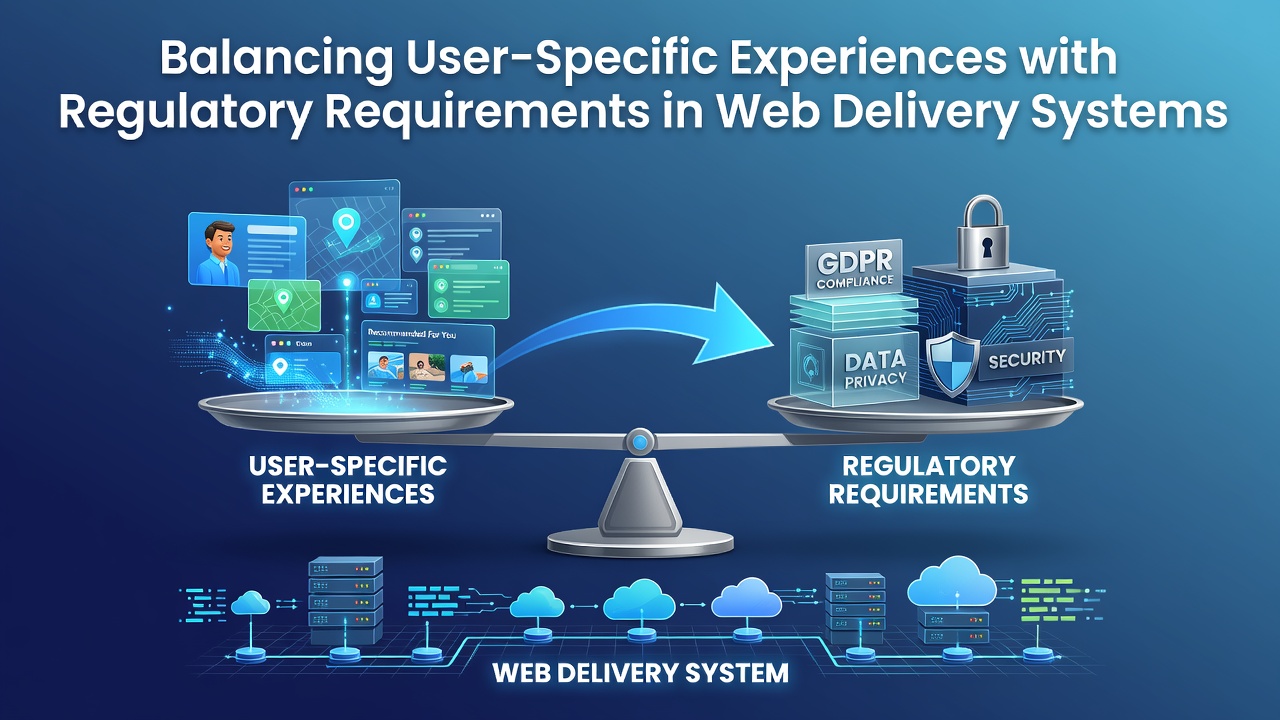
Web delivery systems now handle vast amounts of user data to create tailored experiences, yet they must operate within strict legal boundaries set by data protection laws across multiple jurisdictions. Researchers have documented how companies integrate dynamic content generation with consent management tools, allowing sites to adjust layouts, recommendations, and interfaces based on individual behavior while logging every access decision for audit purposes.
Data from regulatory filings shows that organizations using server-side rendering combined with edge caching can reduce latency for personalized elements without exposing raw user profiles to client devices. This approach separates the delivery of generic templates from the injection of user-specific variables, which helps meet requirements under frameworks like the EU's General Data Protection Regulation and Canada's Personal Information Protection and Electronic Documents Act.
Core Components of Compliant Personalization
Engineers design these systems around modular data pipelines where each stage includes explicit checks for legal basis, purpose limitation, and data minimization. According to teh European Commission, controllers must demonstrate that every processing activity serves a defined purpose and that users receive clear information before any profiling occurs.
One architecture gaining traction involves real-time consent signals passed through API gateways, which then gate access to personalization engines. When a user withdraws consent, the system immediately switches that session to non-personalized content paths, and the change propagates to downstream caches within seconds. Studies from academic institutions in Australia have tracked how such instant revocation mechanisms reduce the risk of over-retention violations.
Technical Implementation Patterns Observed in 2026
By October 2026 many large platforms had shifted toward differential privacy techniques layered on top of recommendation models, adding calibrated noise to aggregated datasets before they influence individual outputs. This method preserves statistical utility for content ranking while limiting the ability to re-identify single users from delivered pages.
Developers also rely on attribute-based access control lists that reference regulatory metadata rather than raw personal identifiers. A request for a news feed might carry a token indicating the user's jurisdiction and consent status, allowing the edge server to select an appropriate variant without ever loading the full profile into memory. Government reports from the Office of the Privacy Commissioner of Canada note that this pattern has become common among organizations handling cross-border traffic.

Monitoring, Logging, and Audit Readiness
Effective systems maintain immutable logs that record which personalization rules fired for each request, including timestamps, consent versions, and the legal basis invoked. These logs feed into automated compliance dashboards that flag anomalies such as unexpected data flows or consent mismatches. Industry analyses indicate that organizations performing quarterly third-party audits of these logs experience fewer regulatory inquiries than those relying solely on internal reviews.
Some teams incorporate synthetic monitoring that simulates user journeys under different consent states, verifying that the system correctly suppresses personalized elements when required. This practice helps surface configuration drift before it leads to enforcement actions.
Challenges When Scaling Across Regions
Rules differ sharply between regions, so global delivery networks must maintain separate rule sets for each jurisdiction and apply them based on inferred or declared user location. Observers note that conflicts arise when one jurisdiction requires data localization while another permits transfers under adequacy decisions, forcing architects to segment storage and processing paths accordingly.
Performance overhead from these checks can accumulate, yet measurements shared in technical papers show that optimized implementations add only single-digit millisecond delays when consent signals are cached close to the edge. Teams that pre-compute compliant variants during off-peak hours further reduce runtime costs.
Conclusion
Web delivery systems that successfully balance personalization and regulation rely on layered controls, real-time consent propagation, and jurisdiction-aware routing. Continued refinement of privacy-enhancing technologies alongside evolving legal standards will shape how these platforms operate in coming years, with October 2026 marking a period of increased focus on automated audit trails and differential privacy integration.